


Still on Dynamics GP in 2026? The Hidden Business Risks and Why Business Central Is the Smarter Path Forward

Updated: Feb 20
For years, Microsoft Dynamics GP has been a dependable ERP system for many organizations. But as we move deeper into 2026, a growing number of business leaders are asking an uncomfortable yet necessary question:
Is staying on Dynamics GP quietly putting our business at risk? Not sure where your Dynamics GP environment stands? Get a structured risk assessment and lifecycle review from our ERP experts.
This question isn’t driven by marketing noise. It’s driven by real product lifecycle changes, rising operational costs, and a fundamental shift in how modern ERP systems are expected to support growth, compliance, and decision-making.
Why This Conversation Is Gaining Momentum in 2026
Microsoft has been very clear about its long-term ERP strategy: the future is cloud-first, and that future is Dynamics 365 Business Central.
While Dynamics GP continues to receive support for now, critical milestones have already passed:
New GP licenses are no longer being sold
Product innovation has slowed significantly
Microsoft’s investment focus has shifted entirely to cloud ERP platforms
For organizations still running GP, this creates a widening gap between business expectations and system capabilities.
The Real Risks of Staying on Dynamics GP

At first glance, remaining on GP may feel like the safest option; familiar workflows, stable operations, and no immediate disruption. However, the long-term risks are increasingly difficult to ignore.
1. Security and Compliance Exposure
As legacy systems age, maintaining security becomes more complex and costly. Reduced enhancements and eventual support limitations increase vulnerability, particularly concerning for organizations operating in regulated or compliance-driven environments.
2. Rising Support and Maintenance Costs
Dynamics GP environments typically require:
On-premises infrastructure and servers
Manual patching and maintenance
Specialized third-party tools
Consultants with increasingly scarce GP expertise
Over time, these costs often exceed the predictable subscription model of modern cloud ERP systems.
3. Shrinking Talent Pool
The Dynamics ecosystem is rapidly evolving. Most ERP professionals are now focused on cloud platforms like Business Central, making GP skills harder to find and more expensive to retain, a significant long-term risk for support and scalability.
4. Operational and Scalability Limitations
Today’s businesses expect real-time insights, automation, seamless collaboration, and scalability across regions and entities. Dynamics GP was not designed for these demands and often relies on workarounds or heavy customization to keep up.
Why Microsoft Dynamics 365 Business Central Makes Sense
Business Central is not just a replacement for Dynamics GP, it represents a modern approach to ERP designed for today’s business environment.
A True Cloud ERP
Business Central eliminates the need for on-prem infrastructure while offering:
Secure access from anywhere
Automatic updates and patches
Predictable, subscription-based costs
This significantly reduces IT overhead and long-term risk.
Deep Integration with the Microsoft Ecosystem
Native integration with:
Microsoft 365 (Outlook, Teams, Excel)
Power BI for real-time reporting
Power Automate and Power Apps for workflow automation
This turns ERP into a connected, collaborative business platform.
Built for Smarter Decision-Making
With real-time dashboards, embedded analytics, and AI-assisted capabilities, Business Central enables faster, more informed decisions without dependency on spreadsheets or manual reporting.
Scalable and Future-Ready
Whether expanding to new markets, managing multiple legal entities, or adapting to regulatory changes, Business Central scales with the business without costly re-architecture.
Why Timing Matters More Than Ever

Although some organizations may technically remain on GP for a few more years, delaying migration introduces avoidable risks:
Increased competition for experienced migration partners
Tighter timelines as support deadlines approach
Higher likelihood of rushed, disruptive projects
Organizations that plan early gain flexibility, reduced risk, and the opportunity to optimize processes rather than simply replicate legacy systems.
Where QuantumQuad Solutions Fits In
Migrating from Dynamics GP to Business Central is not just a technical exercise, it is a business transformation initiative.
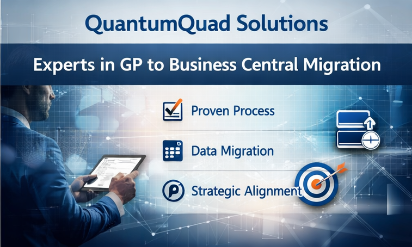
At QuantumQuad Solutions, we bring hands-on expertise across both platforms to ensure:
A realistic assessment of your current GP environment
Clean, accurate data migration
Thoughtful redesign of processes where needed
Alignment of Business Central with long-term business goals
Our approach focuses on stability, scalability, and value not just a successful go-live.
Frequently Asked Questions (FAQs)
Is Microsoft Dynamics GP officially discontinued?
Dynamics GP is not immediately discontinued, but it is in the final phase of its lifecycle. Microsoft has stopped selling new licenses and has shifted all innovation and long-term investment to cloud ERP solutions like Dynamics 365 Business Central.
How long can we safely stay on Dynamics GP?
While GP may remain supported for a limited time, “supported” does not mean “future-ready.” Over time, organizations face higher costs, limited innovation, and increasing dependency risks. From a strategic perspective, early planning is strongly recommended.
Is Dynamics 365 Business Central only for small businesses?
No. Business Central supports complex requirements including multi-entity operations, multi-currency transactions, and industry-specific processes. It is widely adopted by growing and mid-market organizations seeking scalability without excessive complexity.
Will we lose historical data during migration?
No. With a structured migration approach, critical historical data such as financial records, customers, vendors, and open transactions can be migrated accurately. The migration strategy is tailored to business needs rather than a one-size-fits-all approach.
What happens to our GP customizations and add-ons?
Not all customizations need to be replicated. Many GP customizations become unnecessary due to Business Central’s built-in capabilities. Others may be redesigned using modern extensions to ensure long-term maintainability.
Is the migration process disruptive to business operations?
When properly planned, migration does not have to be disruptive. A phased and well-governed approach allows teams to prepare, test, and transition smoothly. Most disruptions occur when migrations are rushed or under-planned.
Why should we work with a specialized partner like QuantumQuad Solutions?
ERP migration is about more than data movement. QuantumQuad’s experience with both Dynamics GP and Business Central allows us to anticipate risks, design realistic timelines, and ensure the solution supports real business processes not just technical requirements.
When is the right time to start planning the migration?
Now. Early planning provides greater flexibility, better access to skilled resources, and significantly lower risk. Even if migration is planned for a later phase, a clear roadmap is invaluable.
The Bottom Line
Staying on Dynamics GP in 2026 may feel comfortable but comfort is not a strategy.
The real question is not whether GP still runs, but whether it still supports where your business is headed.
Microsoft Dynamics 365 Business Central offers a secure, scalable, and future-ready ERP platform. And with the right partner, the transition becomes an opportunity for growth not a risk.

Comments